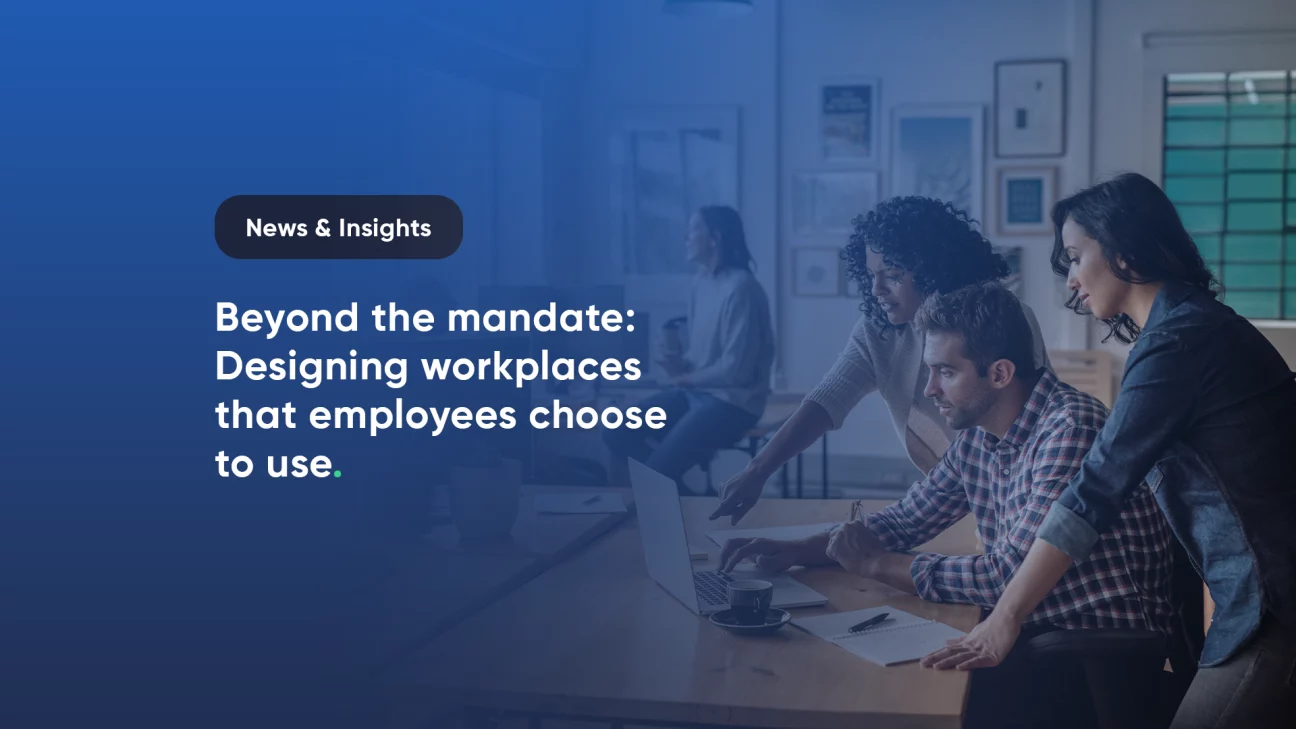
The office should never feel like an obligation. To genuinely magnetize employees, the workplace needs to become a destination that employees actually want to visit. A destination where people can enjoy natural collisions at the coffee machine, across the desk or in the hallway with colleagues. A destination where they can interact and collaborate with their team to build a more personal connection.
All too often on Zoom or Teams calls these days, we tend to jump right into business. But in person, team members can take the time to ask how their colleagues’ kids and family are, how their dog is, how they are. In short, they get to know each other. And that is invaluable.
Just as important is people receiving useful coaching and guidance from simply listening to the conversations around them in the office, whether this be with clients or internal team members. This can spark ideas or inspiration. Brainstorming with nearby colleagues has a similar effect. Let me share an example:
Recently, I spent time in our London office – something I don’t get to do very often as I work remotely from Toronto. During a call with a client, we were discussing a particular challenge and trying to determine the best path forward.
It was one of those moments where a creative solution was needed. If I had been working from my home setup, the next step would have been to schedule another meeting, send a few messages, and wait. Instead, I turned to the colleague sitting next to me and, quite simply, we talked.
Within minutes, we were brainstorming ideas together, building on each other’s thoughts, and quickly arrived at a solution that addressed the client’s needs. The entire conversation happened organically and in real time. There were no calendar invitations, no waiting for availability, and no delays. And let me tell you, the conversation was fizzing with creative ideas.

Where the value of the office lies.
What struck me most was my client’s response. They laughed, and said: “Kat, you should be in the office more often!” That comment stayed with me because it perfectly captured something many organizations are trying to understand today: that the value of the office isn’t the office in and of itself.
It’s the access it offers to people, the knowledge, the experience, and the way it fosters collaboration. It’s the ability to ask a question, share an idea, solve a problem, or build on someone else’s thinking in the moment. It’s all about ensuring that time spent in the office is time well spent.
These interactions are difficult to schedule in a hybrid world, but they are often where the most meaningful work happens. When employees choose to come into the office, they rarely do so merely to sit at a desk. They’re coming for the people, the energy, the conversations, and the opportunities that only happen when they are with others. They’re coming in for the buzz.
But for that to happen, they need to know their team will be there, that the colleagues they like to have coffee with will be in that day, and that they’re going to get a desk. In other words, to attract employees in and to maximize workplace investment, employees will need a purposeful and very human workplace experience.
This is where intelligent workplace management technology, like our Freespace Employee App, bridges the gap. Think of it as a tool designed specifically for intentional connection.
Not only can people book the most appropriate space for their needs and keep track of their desk and meeting room reservations. But they can also see who else will be in the office when they arrive, how busy it’s going to be and where best to locate themselves depending on their requirements that day. If they’re connected, the app even allows them to view colleagues’ schedules and where they plan to sit, so they can opt to sit near them.
This kind of visibility and transparency removes uncertainty, supports intentional connection, and makes the value of coming into the office clear to everyone.
Designing workspaces based on human behavior.
For employers that have condensed their workspaces but may have growing teams, there’s even a feature called Dynamic Allocation. This is based on the idea of anchor days and team days.
So, if it’s a team day and team members are scheduled to come into the office, they’ll be given priority in terms of seating and booking meeting rooms. Instead of logistical headaches for workplace leaders, the system ensures that when a team plans to collaborate in person, they are automatically prioritized for the right seating clusters and meeting spaces. Whether someone has a fixed routine or an appointment calendar that changes daily, it becomes entirely possible to design frictionless days in the office.
But to design spaces based on actual workplace behavior requires being continuously on top of the real-time space utilization data coming in from across the business. This is never a ‘one and done’ activity, or a one-size-fits all approach. Nor based on vague assumptions. Rather, it’s about aligning workplace investments with real human needs.
Patterns of behavior, and the size and type of workforces, will always shift, so workspaces must evolve to meet them. Technology shouldn’t just track where people sit. It should make it easier for them to collaborate, create, and experience those “fizzing” moments of innovation. This is the workplace of the future – where employees don’t show up because they have to, but because that’s where the magic is happening.