For the past five years, the corporate world has been obsessed with the ‘where’ and ‘how often’ we work. We have argued over anchor days, debated the merits of mandates, and agonised over what flexibility really means for employees.
But as we move into 2026, things are changing.
A vast majority of organizations have now successfully established their hybrid working policies and communicated these to their teams, but many are finding that a policy on paper doesn’t always translate to a high-performing office in practice.
Why?
Because they haven’t yet entered the era of the ‘managed workplace’.
In the managed workplace, success is no longer defined by whether people show up, but by how intelligently we can orchestrate the environment they work in.

The three phases of hybrid work.
To understand where we are going, it’s helpful to look at where we have come from. A brief look back over the last decade is helpful:
- Phase 1: Survival (2020–2022): The covid era and a frantic pivot to remote working. Digital tools were lacking, people were anxious, and confusion was rife. Policy struggled to keep up.
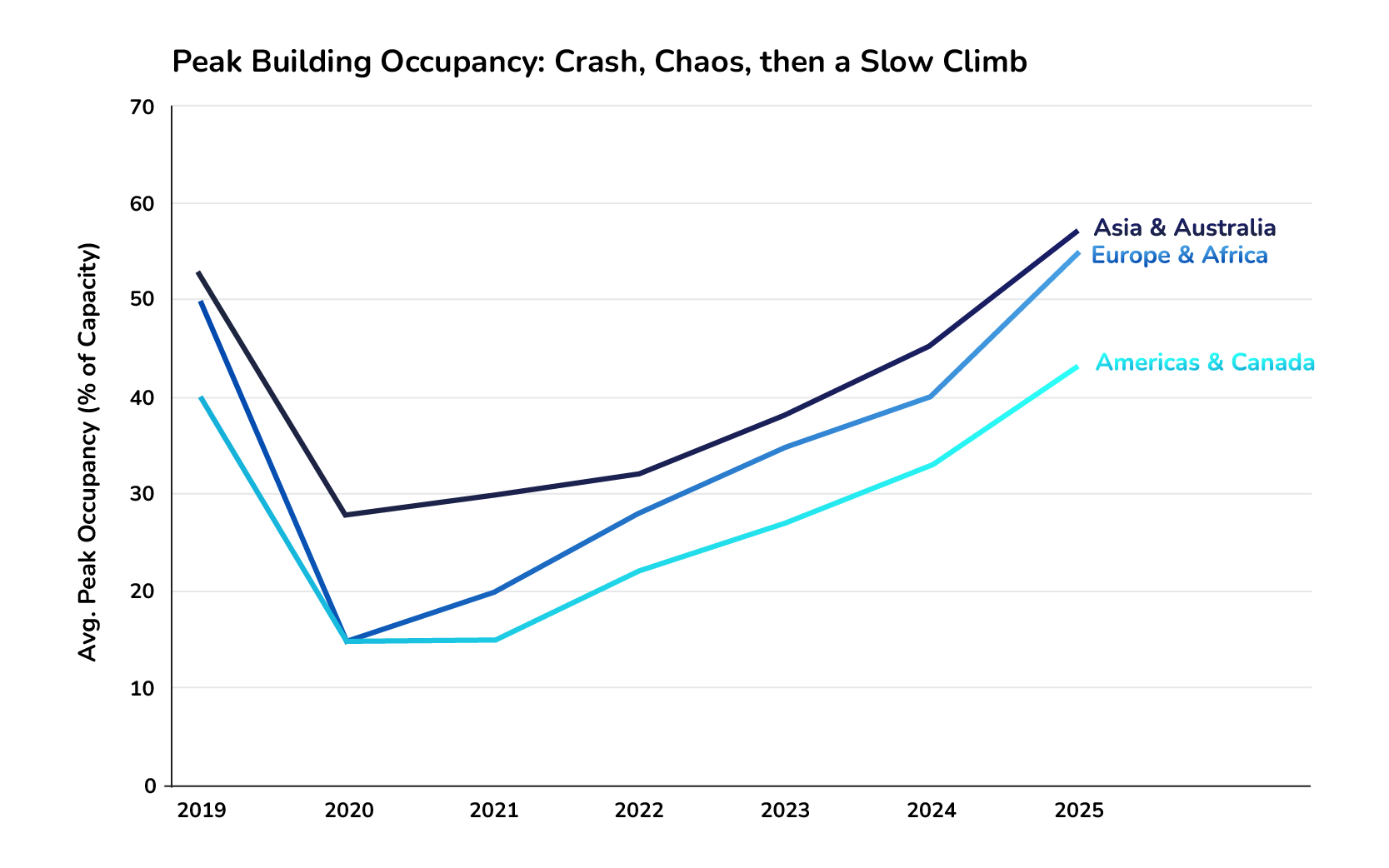
Peak building occupancy fell from roughly 40-55% pre-pandemic to near 15-28% within months of the pivot to remote work, then spent the next two years hovering around that same range without a steady recovery. The workforce seemed to react month to month rather than adhering to a return-to-work plan. Occupancy didn’t start a steady, uninterrupted climb until 2022, the point at which policy visibly caught up with behaviour. It took until 2025 for most regions to get back to, or past, where they were pre-pandemic.
- Phase 2: Policy (2022–2025): Organizations experimented with mandates, around employees using anchor days, and flexible frameworks. Workplaces issued hybrid polices.
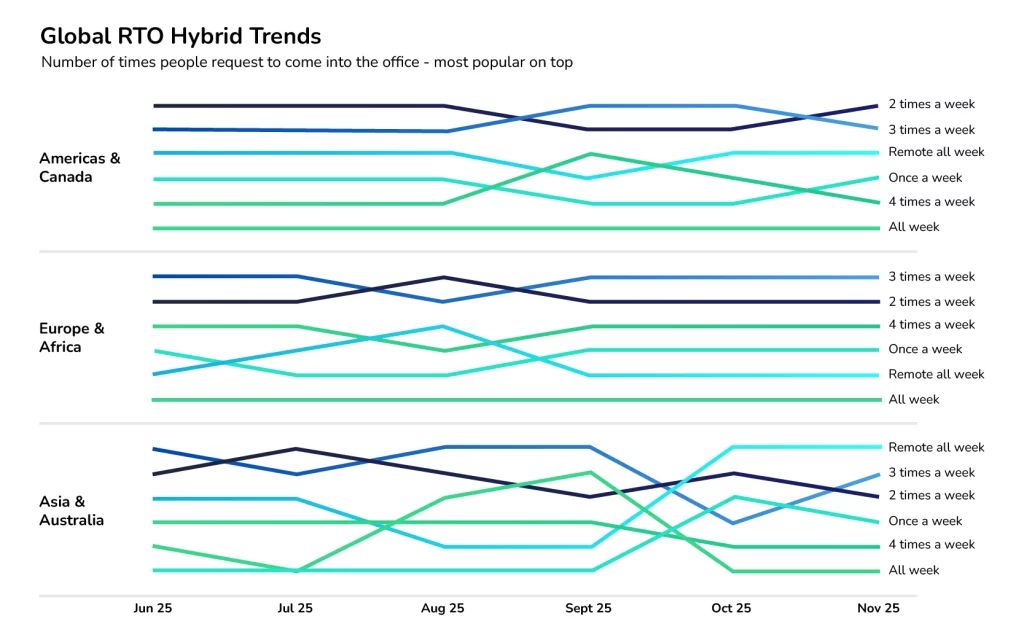
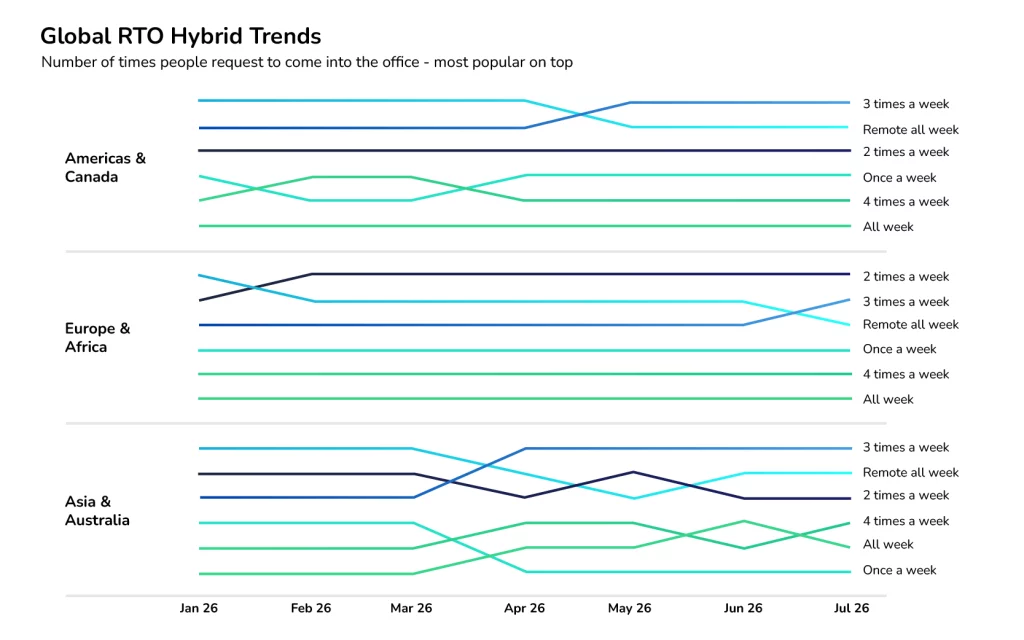
Through mid-to-late 2025, the hybrid attendance pattern kept changing region by region as people adapted to policy and then reverted to older ways of working. In the Americas, the pattern swapped between “3x/week” and “2x/week” twice within six months. In Asia & Australia, the leading pattern reshuffled almost every month. Europe was the exception (“3x/week”) and held the top spot the whole period. That’s a region still testing anchor days and flexible frameworks rather than converged on one.
- Phase 3: Management (Now): Focus shifts to performance, coordination, and real-time optimization. Leaders are realizing that a policy alone is not enough. They need to take a more active approach to managing hybrid environments.
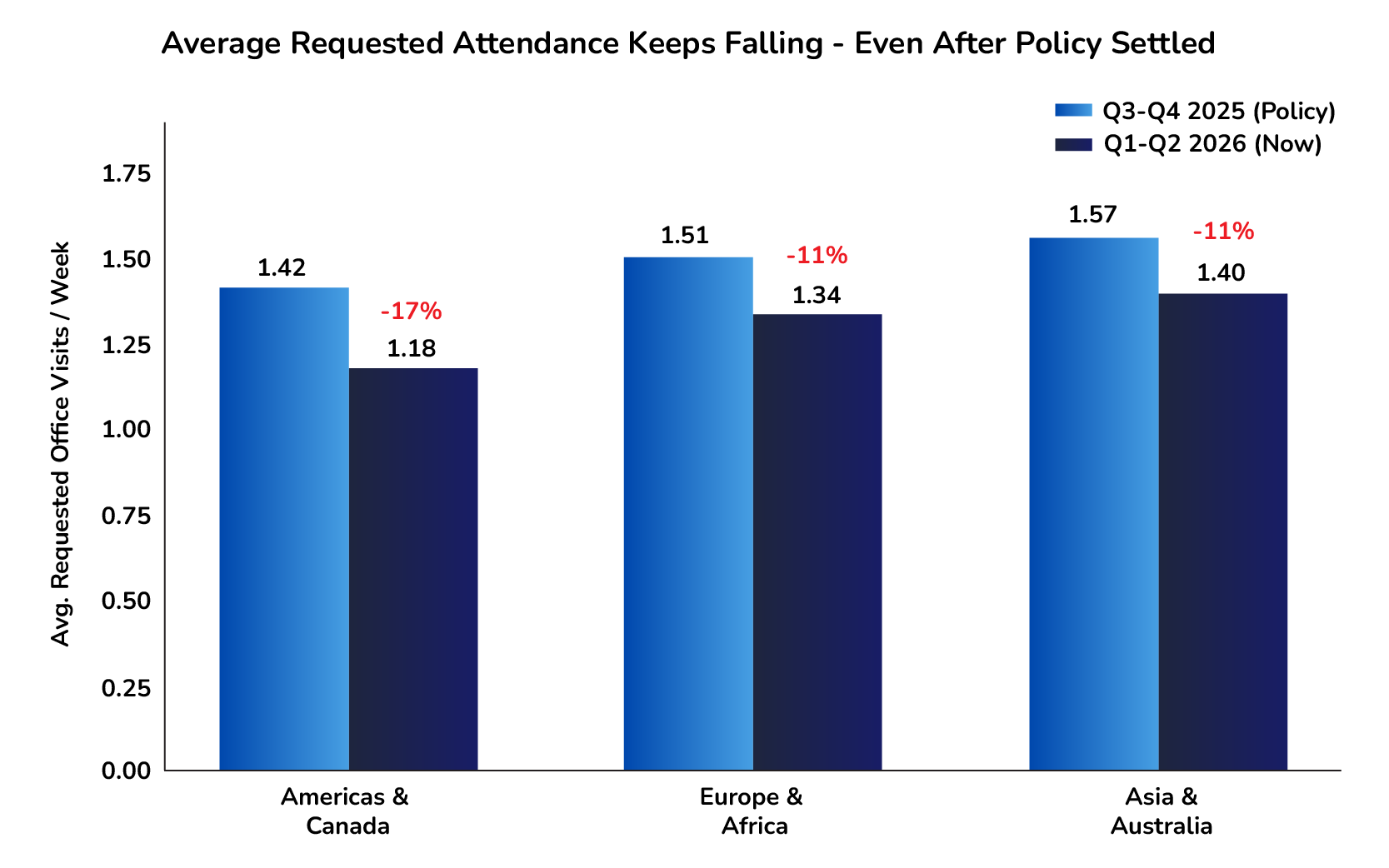
Q1 & Q2 2026, the picture split. In the Americas and Asia & Australia, the leading pattern locked in at “3x/week” and held there. Yet average attendance still fell 17% and 11% respectively. In Europe, the leading pattern dropped from “3x/week” in 2025 down to “2x/week,” alongside an 11% drop in average attendance. So even where a preferred cadence held steady, weekly attendance has dropped. What is clear, is that globally, mandated RTO isn’t controlling actual attendance.
The challenge in 2026 is no longer about defining hybrid working or creating policy around it. Rather, the challenge today, is engineering hybrid working effectively to get the best return on investment – both in terms of real estate costs and employee experience.
In short, workplaces will need to shift from defining the rules of hybrid work to actively managing its operational reality.
Hybrid work has stabilised, but it has not yet simplified. It’s time to move the conversation from “home vs. office” onto operational efficiency.
Workplace frictions.
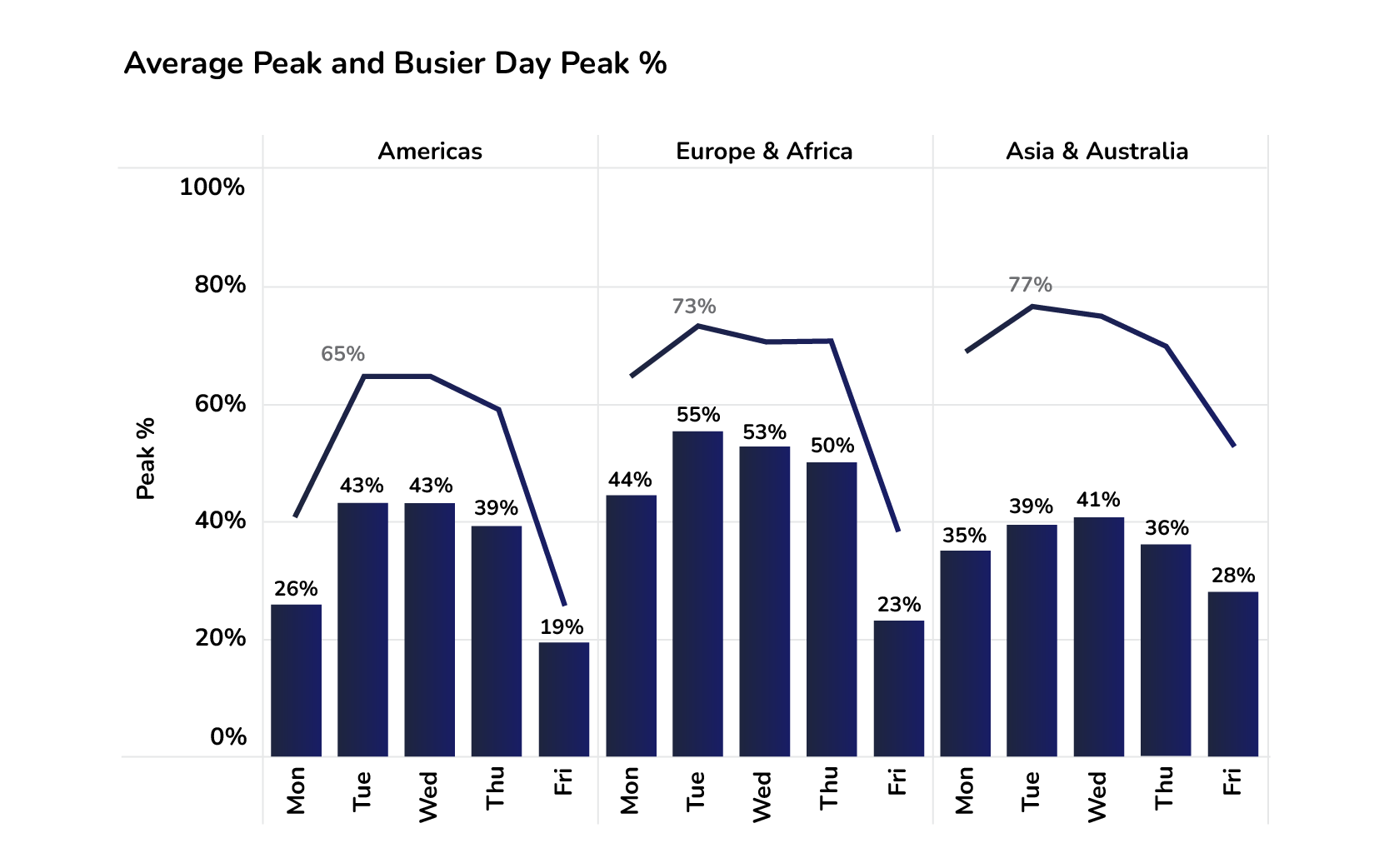
Whether an organization mandates three days in the office, or offers total flexibility, the operational results are becoming remarkably consistent. Global peak occupancy is rising (up 5% year-on-year), but that growth is rarely spread evenly during the working week. While Mondays and Fridays remain quiet (often referred to as ‘workplace ghost towns’), Tuesdays through to Thursdays have become high-pressure zones.
Our data also shows a disconnect: 75% of meetings globally involve only two to three people, yet most offices are still dominated by large, formal boardrooms which seem significantly oversized relative to the groups using them.
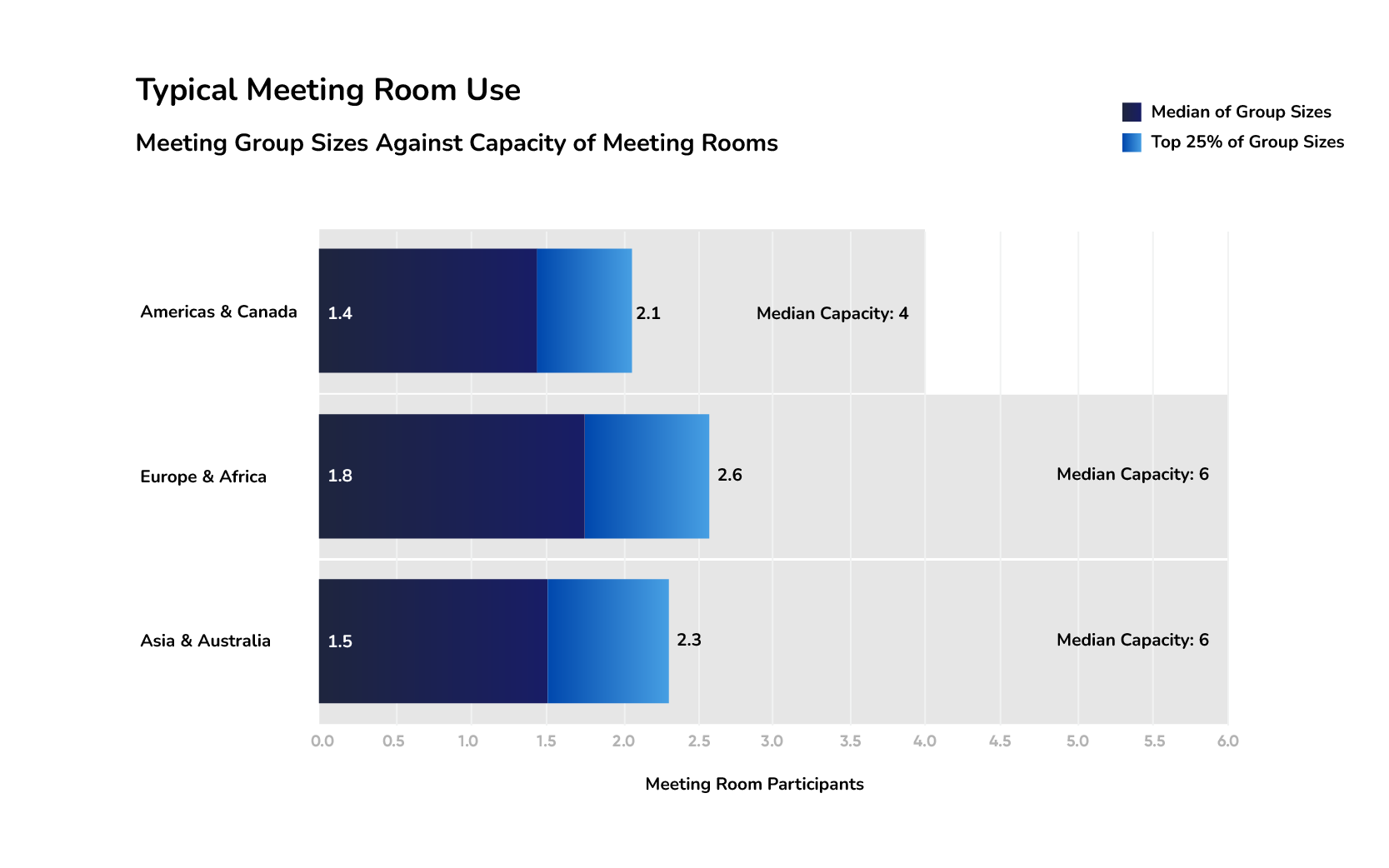
Whilst larger spaces have their purpose – the key question is whether we need quite so many in the modern workplace?
On top of this we’re seeing a growing disconnect between what senior executives believe employees want from an office space and their employees’ actual lived experience. In the past, we have seen employers making decisions about office size and layout based on assumptions, but with better access to intelligent data, leaders can make informed decisions.
Beyond the immediate friction of a crowded Tuesday, there is also a more expensive problem, the carbon footprint of an empty office. The most expensive, and carbon-intensive office is the one that is heated, cooled, and lit up, but entirely empty for three days a week.
An active approach.
To unlock true value today, we need to follow data. Doing so helps employers understand how their people use their workplace environments and recognize any underlying patterns. Shifting the focus from assumptions to consistent, evidence-led decisions will provide assurance about where space is genuinely required, where it is underused, and where the environment is no longer fit for how teams work.
By leveraging sensor data alongside desk-booking and check-in insights, organizations can move beyond assumptions and model real-world scenarios for managing their office space with confidence.
This will result – not only in optimized attendance – but also in an office footprint that better meets employee needs, thereby creating more effective and engaging places to work and ensuring better ROI on real estate spend.
The shift from a policy era to a managed workplace era is being accelerated by AI too. Until recently, workplace management has been retrospective, allowing leaders to look back at old data to make next year’s decisions. In the managed workplace however, we can use AI to move from retrospective insights to active orchestration.
Active orchestration is an office that knows when employees are due in and understands how they best like to work. For instance, instead of an employee spending 15 minutes searching for a desk near their team, AI-driven booking systems can nudge teams toward specific areas based on their needs. This means to proof that when employees do commute to the office, the environment there actually supports the work they came to do.
With today’s AI capabilities, IoT-driven building data available at scale can lead to intelligent localized solutions delivered flexibly and with agility through models that can forecast demand, surface risks and opportunities, and recommend optimized portfolio and workplace design decisions. In short, AI allows us to move beyond assumptions toward a system that responds in real-time.
A shift in mindset.
The transition to a managed workplace requires a sizeable shift in mindset.
- Workplace leaders would do well to focus on removing the friction of coming into work, start ensuring spaces are used correctly and consolidate underused spaces.
- They can also bridge the data-action gap. Leaders will need to do more than collect occupancy data, they need to act on it.
- Leaders should look to use occupancy data to eliminate the invisible waste of powering and cooling empty areas. By synchronizing building systems with actual human presence, sustainability becomes an automated byproduct of smart management.
- Leaders can utilize AI to enable a fundamentally different approach to workplace management. Rather than relying on static workflows or retrospective insights, leaders can use tech to create an environment that can respond dynamically to changing attendance patterns, behaviours, and space usage.
Workplace design leaders who combine granular, building-level data with flexible, regionally tailored strategies can transform office portfolios into efficient, employee-centric ecosystems that support the hybrid workplace.
The managed workplace moves beyond static floor plans and instead uses real-time occupancy data to close off underused zones on low-attendance days like Fridays, concentrating teams into active hubs, while slashing heating, air-conditioning and cleaning costs in vacated areas. It’s the shift from paying to power an empty building to investing only in the space being used.
Hybrid work is no longer a policy decision; it is a systems and coordination challenge.
The organizations that will win in 2026 will be those that start to proactively manage their environment for the better. This is the era of the managed workplace. One where the office finally works as hard as the people inside it.
Freespace IQ Report.
All data is sourced from our Freespace IQ report. Discover the global office trends shaping how and where people work. This report combines data from 185,000+ spaces and 8 million bookings to reveal emerging patterns and workplace behaviors. Sign up today to discover more global trends and insights.