The New Office Playbook.
In early September, over 6,000 real estate executives, technologists, investors, and innovators gathered at the InterContinental London at The O2 for PropTech Connect Europe – Europe’s premier real estate technology event, set against a backdrop of rapid AI integration and shifting workplace demands.
Across two action-packed days of keynotes, tech showcases, and high-level networking, one central theme dominated the stage and discussions throughout the event: How do we balance space, cost, and performance in an AI-driven, hybrid world?
During the event, Freespace’s own Raj Krishnamurthy joined an expert panel titled “The New Office Playbook: Rethinking Space, Costs, and Performance in a New Market.”
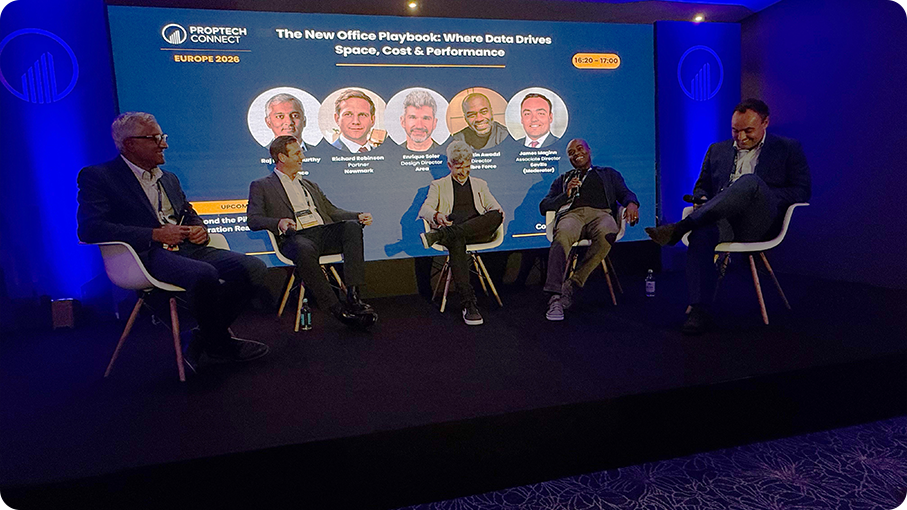
Moderated by James Maginn (Savills), the panel featuring Richard Robinson (Newmark), Enrique Soler (AREA) and Austin Awadzi (Fibre Force) moved beyond the traditional work-from-home versus return-to-office debate, exploring fresh perspectives on culture, sustainability, data, and the evolving role of the physical workplace.
Read on to discover five key takeaways from this panel – and hear some of the anecdotes shared by the speakers about the new office playbook.
1. The office is no longer just where the work happens.
The office is where relationships are formed, and collaborations happen. When asked whether the physical office is pivoting from a production hub to a relational one, the panel was resoundingly aligned. Certainly, digital tools can handle task execution, but they struggle to replace the trust and spark moments that can happen in person and in the office.
“You connect when you see a sparkling eye. It’s a different experience. Meeting a client face to face, or gathering your team, drives trust and better relationships.”
Raj Krishnamurthy, Freespace.
Highlighting the balance between autonomy and presence, Austin Awadzi from Fibre Force emphasized that modern workplace policies must empower employees.
“Employers should treat staff as adults, letting them choose where they work based on delivery and life needs. But true collaboration happens where relationship-building meets efficient work.”
Austin Awadzi, Fibre Force.
Rather than enforcing rigid mandates, the hybrid policies of 2026 should offer freedom, positioning the office as a destination for meaningful connections.
2. Workplace professions need to shift their focus; targeting waste and not just focusing on costs.
A recurring theme of the panel discussion was the danger of chasing short-term cost cuts at the expense of workplace identity and longer term value. The panellists noted that investing in better collaboration environments and defining clear cultural DNA can create far greater returns than simply cutting workspace. Richard Robinson of Newmark cited research demonstrating that firms with high workplace identity scores outperform peers by 22%.
“Focusing on cost reduction alone is the wrong target. Companies should target waste and underutilisation instead, letting cost savings follow as an outcome. Investing in employee-friendly environments drives real productivity.”
Richard Robinson, Newmark.
3. AI will increase the need for physical workspaces.
Perhaps contrary to popular belief AI will not render the physical workplace (and our jobs within it) obsolete. Rather the tech actually increases the need for physical spaces for employees. As AI performs the low-level operational tasks, employees are freed up for deeper communication, creative strategy, and relationship-building.
“AI doesn’t need space; we do.”
Enrique Soler, Area.
That said, the panel issued a strong warning regarding talent pipelines. They advised against cutting entry-level and graduate roles and replacing with automation. Not only will this risk multiple jobs, but it could well create a leadership shortage in years to come. The panel agreed that today’s graduates are AI natives who will use these tools more skilfully than previous generations. But companies must invest in their growth and give them spaces to collaborate.
4. Business resilience is high for big crises, but slow change poses a substantial risk.
Businesses have proven highly resilient when adapting to sudden shocks and crises (such as the pandemic and geopolitical crises). But slow-moving, structural shifts, such as climate change and long-term cultural evolution, may well pose a much more substantial risk.
“As businesses, we’ve done well with shocks. Events happen and we adjust. I think what we will look back on and realize is that we don’t deal well with slow change, and the slow change is going to get us eventually.”
Raj Krishnamurthy, Freespace.
5. We are entering the era of the managed workspace.
In the managed workplace, success is not defined by whether people show up to the office, but by how intelligently we can orchestrate the environment they work in. Panellists discussed innovative ways to tackle space inefficiencies, such as near-empty Mondays and Fridays, and high-pressure zones during the middle of the week.
It was suggested that structuring whole-team schedules so different departments rotate through shared spaces throughout the week would help to maximize use of space, without needing any extra workplace footprint.
In addition, the use of intelligent controls was celebrated during the panel discussion. Workplace professionals were urged to utilize algorithms and occupancy data to dynamically control floor access, HVAC, and elevator routing on lower-density days.
Addressing an audience question on how to handle empty floors, Raj highlighted progressive ideas taking shape in places like New York.
“Regulations are being explored where cities mandate that elevators won’t stop at certain floors on low-occupancy Mondays and Fridays. The energy savings created by not heating, cooling, or servicing those empty floors are then shared directly between the occupiers and the landlords. It’s a win-win for sustainability and cost.”
Raj Krishnamurthy, Freespace.
Whether through AI-assisted scheduling or dynamic HVAC and elevator routing, managing space actively, rather than passively, was deemed essential.
Looking ahead.
As tech – and more specifically AI – accelerates, it raised an existential question that was so clearly on many of the minds in the room: Will AI reduce the need for physical workplaces, or does it actually increase our need for human connection?
The panel’s verdict was unanimous: AI will not replace our workplaces. Rather it will remind us just how much we need them.
So, whilst automation handles the doing, our workplaces will provide us with the space for employee belonging and connection.
“AI will increase the need for workspaces.”
Raj Krishnamurthy, Freespace.
To learn more about how Freespace helps organizations measure, optimize, and transform their workplace experience, explore our solutions at afreespace.com.